 中文
中文
Service Center
WhatsApp/Wechat
+86 18576510428
Working Time
Monday to Friday
E-mail
info@fswesternland.cn
E-mail
mia@fswesternland.cn
E-mail
kikko@fswesternland.cn

Abby

Mia

Kikko

Complete Total Stone Processing Workflow: From Cutting to Polishing
2026-01-15 15:31:31
Click:
“
he complete stone processing workflow covers pre-processing preparation, core stages of cutting with diamond saw blades, grinding with diamond grinding wheels and polishing with abrasive pads, plus post-processing sealing and quality inspection. It specifies tool selection for different stones and operational tips, highlighting that proper tool matching ensures high-quality stone products and production efficiency.
”
The stone processing industry relies on a systematic workflow to transform raw stone blocks into high-quality, usable products like countertops, flooring tiles, and decorative panels. From the initial cutting stage with diamond saw blades to the final polishing with abrasive pads, each step requires precise tool selection and operational skills.
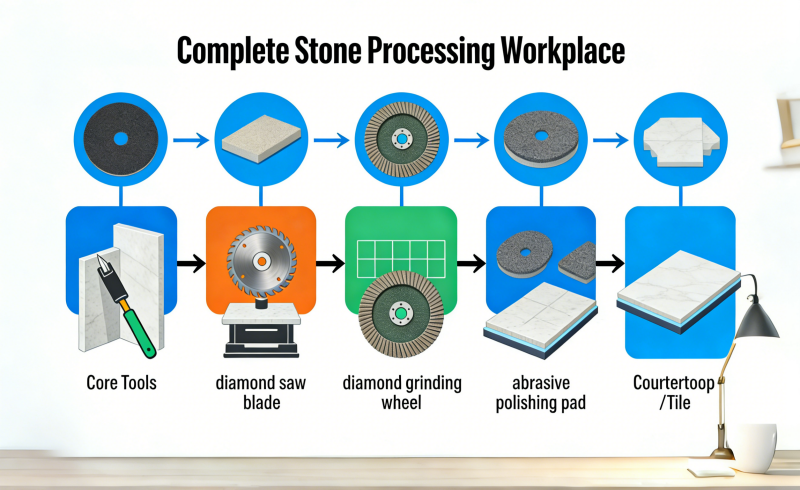
This guide details the complete stone processing workflow, highlighting key tools, techniques, and tips to ensure efficient production and superior finishes. Core keywords: stone processing workflow, diamond saw blade, stone cutting tools, abrasive polishing pads, stone finishing process.
1.Pre-Processing: Material Preparation & Tool Setup
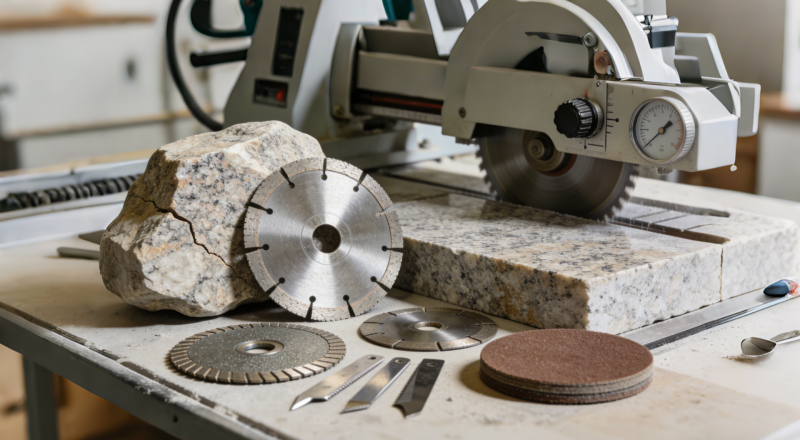
Before starting the core processing, proper preparation lays the foundation for smooth operations. First, inspect the raw stone blocks (e.g., granite, marble, ceramic) for cracks, impurities, or unevenness—these flaws can affect processing quality. Next, select the right tools based on stone type and hardness: for hard stones like granite, choose high-concentration diamond saw blades; for soft marble, opt for thinner, sharper blades to avoid chipping. Ensure all tools are properly installed, with saw blades tightened and polishing pads attached securely to the machine. Key preparation steps also include adjusting machine parameters (e.g., saw blade rotation speed, feeding rate) to match the stone’s characteristics.
2. Core Stage 1: Cutting with Diamond Saw Blades (Shaping the Stone)
Cutting is the first critical step in shaping raw stone into desired sizes and forms. As the most essential cutting tool, diamond saw blades are preferred for their high hardness, wear resistance, and precision—making them ideal for processing various stone materials.
2.1 Common Cutting Methods & Tool Selection
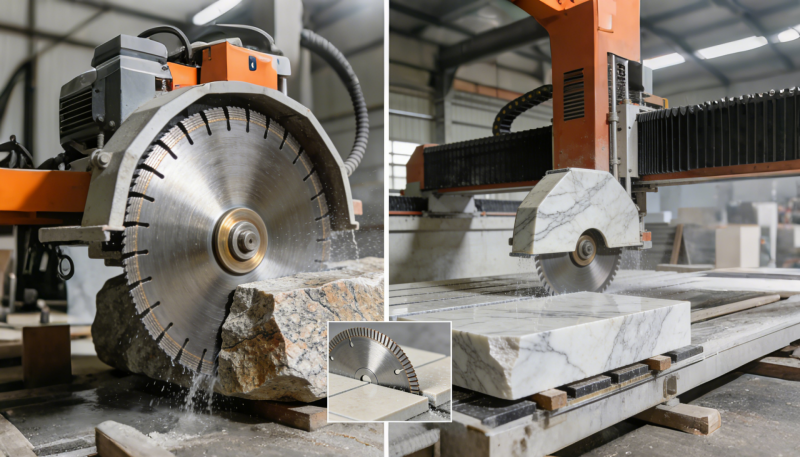
Block Cutting: Use large-diameter diamond gang saw blades or bridge saw blades to cut raw stone blocks into slabs of uniform thickness. For granite blocks, select diamond saw blades with a metal bond—they offer strong abrasion resistance for long-term use. For marble blocks, resin-bonded diamond saw blades are more suitable, as they cut smoothly without damaging the stone’s delicate texture.
Slab Cutting: After block cutting, use medium-diameter diamond circular saw blades to trim the slabs into specific sizes (e.g., standard countertop dimensions). For ceramic tiles, thin-walled diamond saw blades are recommended to ensure clean, precise cuts without edge chipping.
2.2 Key Cutting Tips
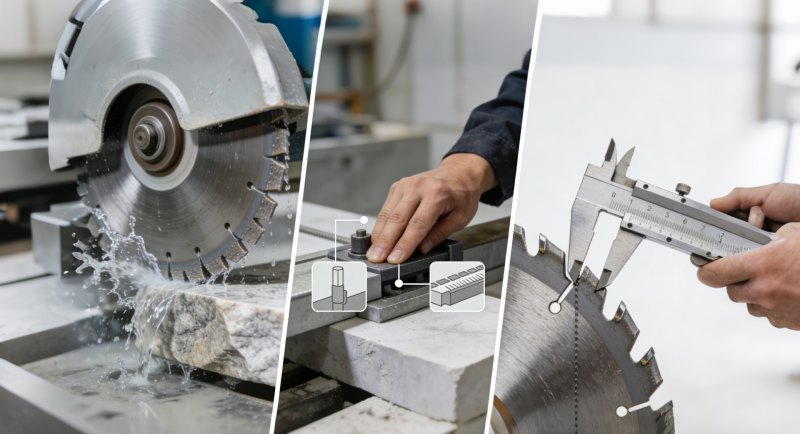
Always use water cooling during cutting—this reduces heat buildup, prevents the diamond saw blade from overheating and losing sharpness, and minimizes dust pollution. Avoid excessive feeding pressure, as it can cause blade deformation or stone cracking. Regularly check the saw blade’s sharpness; replace or re-sharpen dull blades promptly to maintain cutting efficiency and quality.
3. Core Stage 2: Grinding (Refining the Surface)
After cutting, the stone surface is rough with cutting marks, so grinding is necessary to refine the surface and prepare it for polishing. This stage uses diamond grinding wheels or abrasive blocks of different grits to gradually smooth out unevenness and scratches.
Start with coarse-grit grinding tools (50-150 grit) to remove deep cutting marks and level the surface. For hard granite, use diamond grinding wheels with high diamond concentration; for soft marble, choose gentle abrasive blocks to avoid surface damage. Then switch to medium-grit tools (200-400 grit) to further refine the surface, reducing the depth of remaining scratches. Ensure uniform pressure during grinding to avoid uneven surfaces—this is crucial for achieving a consistent finish in the subsequent polishing stage.
4. Core Stage 3: Polishing with Abrasive Pads (Achieving Glossy Finish)
Polishing is the final step that enhances the stone’s aesthetic appeal, transforming the smooth grinding surface into a glossy, durable finish. Abrasive polishing pads—especially diamond polishing pads and resin polishing pads—are the core tools for this stage, as they can adapt to different stone types and achieve varying levels of gloss.
4.1 Polishing Process & Pad Selection
Fine Grinding (600-1000 Grit): Use fine-grit diamond polishing pads to create a semi-glossy surface, removing any remaining fine scratches from the grinding stage. Resin-bonded polishing pads are ideal here, as they offer good flexibility and finish quality.
Final Polishing (1500-3000 Grit): For a high-gloss finish, use ultra-fine-grit polishing pads. For granite, resin-bonded diamond polishing pads are recommended to achieve a mirror-like shine; for marble, wool polishing pads combined with polishing powder can enhance gloss while protecting the stone’s natural veins. For ceramic tiles, ceramic-specific resin polishing pads are the best choice to restore the tile’s original smoothness and gloss.
4.2 Polishing Tips
Maintain a consistent polishing speed and pressure—too much pressure can damage the stone surface, while too little pressure results in uneven gloss. Keep the surface moist during polishing to improve the finish and extend the life of the polishing pads. After polishing, clean the stone surface thoroughly to remove any polishing residue, revealing the stone’s natural color and texture.
5.Post-Processing: Sealing & Quality Inspection
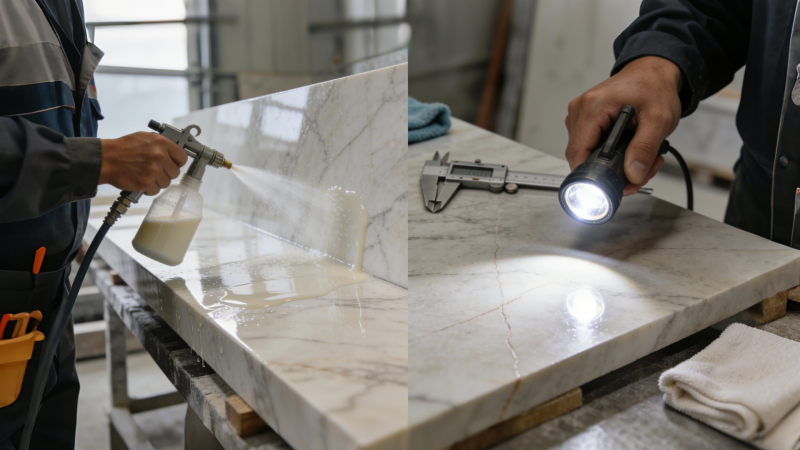
After polishing, apply a stone sealer to porous stones like marble and granite. The sealer penetrates the stone’s pores, forming a protective layer that resists stains, water damage, and wear—extending the stone’s service life. Finally, conduct a quality inspection: check the surface for scratches, uneven gloss, or chipping; verify that the dimensions meet the requirements; and ensure the stone is clean and free of defects.
Conclusion: The Importance of Tool Matching in the Workflow
A smooth, efficient stone processing workflow relies heavily on matching the right tools to each stage. From the cutting stage with diamond saw blades to the polishing stage with abrasive pads, selecting high-quality, stone-specific tools is key to achieving superior finishes, reducing production costs, and improving efficiency.
By following this complete workflow and using the correct tools, stone processing professionals can consistently deliver high-quality products that meet customer expectations.
Core keywords recap: stone processing workflow, diamond saw blade, abrasive polishing pads, stone cutting tools, stone finishing.








Contact Us
Send your message to us


点击右上角
分享给朋友吧
WhatApp/WeChat:
+8618576510428
+8613450822915
Email: info@fswesternland.cn
Email: mia@fswesternland.cn
Email: kikko@fswesternland.cn
Address: Room 1505, Baoneng Financial Building, No. 8 Junlan Road, Dongping Community, Lecong Town, Shunde District, Foshan City
WhatApp/WeChat:+8618576510428
Email: info@fswesternland.cn
Address: Room 1505, Baoneng Financial Building, No. 8 Junlan Road, Dongping Community, Lecong Town, Shunde District, Foshan City
Copyright © 2024 Foshan Western Land New Material Co, Ltd. All Rights Reserved.
